Showing posts with label developing ideas. Show all posts

Thursday, August 17, 2023

How to Turn an Idea into a Great Story: Making Muscular Action! #writing #amwriting #NaNoWriMo

Are you doing planning to write a novel National Novel Writing Month (NaNoWriMo)? You may wonder how you can possibly develop your novel enough to get 50,000 words. Start planning now! Learn how to expand a story by increasing the action for a strong middle.

“I love it,” the editor said. “I want to buy it.”

Words every writer wants to hear. But such joy does not come without a price. In this case, the editor followed those lovely phrases with “It needs to be twice as long.”

But I already had a plot that worked, and a nice fast pace! All in ... uh ... just over 80 pages. So yeah, that was short, even for a children’s novel. And since I was pitching The Ghost on the Stairs as the first in a series, it had to match Aladdin’s series guidelines for ages 9 to 12. So I had to add 70 pages, while keeping the story fast and active.

Some of you are going, “Yeah, right—I always need to cut, not expand.” That’s a common problem for many, but filling out a story with exciting, dramatic material can cause challenges as well—especially in the middle, where plots can sag and slow. I also see a lot of beginning children’s writers with manuscript in the 5000- to 20,000-word range, a tough sell unless you are doing leveled readers—which often have a very specific word count for each age level. Adult novelists may wind up with novellas, where a full-length novel would have better market opportunities.

So how do you build a bigger manuscript, while keeping it lean and muscular, not padded with fat descriptions or flabby repetition? I studied books on plotting, including Elements of Fiction Writing - Beginnings, Middles & Ends (Nancy Kress, Writers Digest Books) and came up with the several literary “protein shakes” to feed my novel. 

Add More Plot

In my Haunted series, siblings Jon and Tania travel with their mother and stepfather’s ghost hunter TV show, and discover Tania can see ghosts. In each book, they have to figure out what’s keeping the ghost here, then try to help her or him move on. In the version of The Ghost on the Stairs I sent to the editor, people already knew the ghost’s name and why she’s stuck here grieving. To expand the manuscript, I made the ghost story more vague. Jon and Tania have to do detective work to discover her name and background.

Exercise: Make a plot outline of your manuscript, with a sentence or two describing what happens in each scene. How easily does your main character solve his problems? Can you make it more difficult, by requiring more steps or adding complications? Can you add complications to your complications, turning small steps into big challenges?

Example: In Haunted Book 2: The Riverboat Phantom, a ghost grabs Jon.

    I felt the cold first on my arms, like icy vice grips squeezing my biceps. Then waves of cold flowed down to my hands, up to my shoulders, all through my body.
    I tried to breathe, but my chest felt too tight.
    My vision blurred, darkened. The last thing I saw was Tania’s horrified face.
    And I fell.

That’s dramatic enough for a chapter ending. So what’s next? It would be easiest—for Jon and the writer—if Tania is still the only one there when he recovers, and no one else notices his collapse. But if everyone notices, and Jon has to convince his worried mother that he’s not sick, you get complications.

See the "plotting" label to the right for more advice.

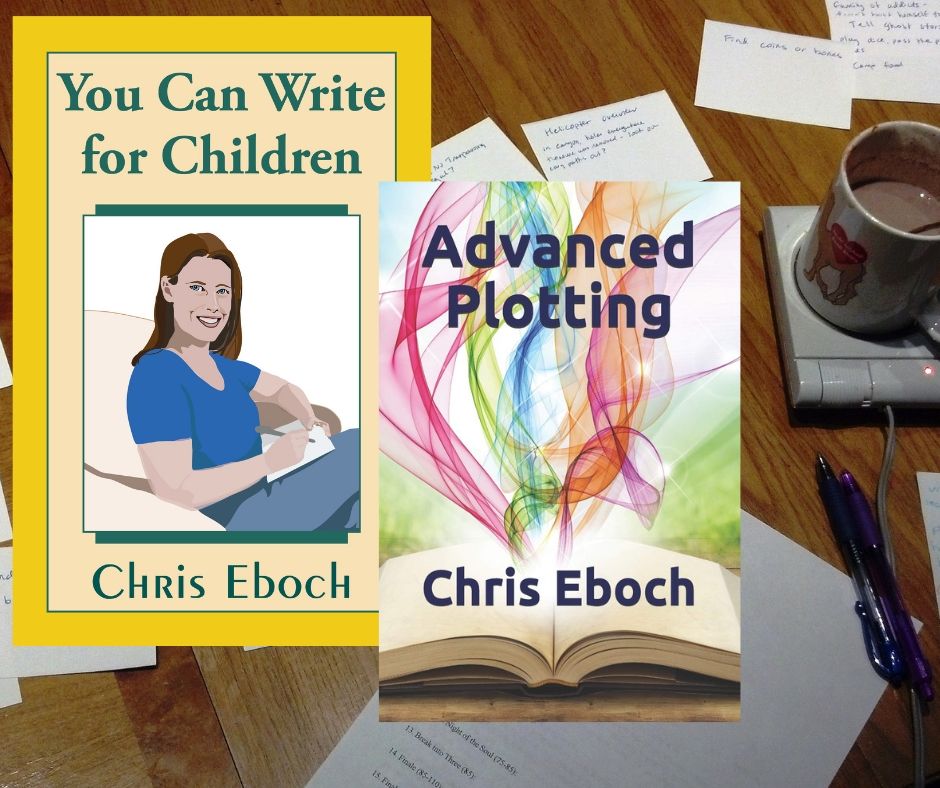
Hire Chris for a developmental edit or take a self-paced online class:

Advanced Plotting—Keep Those Pages Turning

Learn advanced techniques that will make a decent plot dynamic. Start with a “grab you by the throat” opening, pack the plot full, maximize your pacing, and use cliffhanger chapter endings to drive the story forward.

Take this online course at your own pace. It includes six videos plus handouts with notes and more resources. Get Advanced Plotting here.

Please note: If you are new to EzyCourse, you will need to sign up and get a password first. Then return to the course page to enroll and pay. You will not have access to the course until you "Complete Purchase." 

You Can Write for Children

Learn about children’s publishing—opportunities and challenges, genres, age ranges, book and magazine markets, and resources to keep you going. Watch this three-session video course at your own pace. Get You Can Write for Children here.

Chris Eboch is the author of  Advanced Plotting. Get Advanced Plotting from Amazon. 

Children's writers will get a great overview of writing books for kids in You Can Write for Children: A Guide to Writing Great Stories, Articles, and Books for Kids and Teenagers. It is available in Kindle, in paperback, or in Large Print paperback. Get You Can Write for Children.

Chris Eboch is the author of over 100 books for children, including nonfiction and fiction, early reader through teen. Her novels for ages nine and up include The Eyes of Pharaoh, a mystery in ancient Egypt; The Well of Sacrifice, a Mayan adventure; The Genie’s Gift, a middle eastern fantasy; and the Haunted series, about kids who travel with a ghost hunter TV show, which starts with The Ghost on the Stairs

Learn more at 
her website or her Amazon page.

Chris also writes for adults under the name Kris Bock. 
She writes a series with her brother, scriptwriter Douglas J Eboch, who wrote the original screenplay for the movie Sweet Home Alabama. The Felony Melanie series follows the crazy antics of Melanie, Jake, and their friends a decade before the events of the movie. Sign up for the romantic comedy newsletter to get a short story preview, or find the books at Amazon US or All E-book retailers.

Kris Bock writes novels of mystery, suspense, and romance. In the Accidental Detective series, a witty journalist solves mysteries in Arizona and tackles the challenges of turning fifty. Kris’s Furrever Friends Sweet Romance series features the employees and customers at a cat café. In the Accidental Billionaire Cowboys series, a Texas ranching family wins a fortune in the lottery, which causes as many problems as it solves. 

Sign up for the Kris Bock Mystery and Romance newsletter and get a free Accidental Detective short story and bonus material, a free 30-page sweet romance set in the world of the Furrever Friends cat café, and a printable copy of the recipes mentioned in the cat café novels.

Learn more at her website or visit her Amazon page.

Monday, August 14, 2023

You Can Write Strong Stories: The Best Ways to Raise the Stakes for your #NaNoWriMo Novel - #amwriting #Writing

When writing a novel, it's common to hit a slump somewhere in the middle. What happens next? How can you keep the story going strong? 

Let’s talk about the stakes – and how to raise them.

Look at your main story problem. What are the stakes? Do you have positive stakes (what the main character will get if he succeeds), negative stakes (what the MC will suffer if he fails), or both? Could the penalty for failure be worse? Your MC should not be able to walk away without penalty. Otherwise the problem was obviously not that important or difficult. The penalty can be anything from personal humiliation to losing the love interest to the destruction of the world – depending on the length of story and audience age – so long as you have set up how important that is for your MC.

Are things worse
at page 200?
Note that those complications should also be both Difficult and Important. Say you have a character who needs to get somewhere by a specific time, and you want to increase tension by causing delays. If she simply runs into a series of chatty neighbors, it’s quickly going to get boring (unless you can push it to the point of comedy). 

Instead, find delays that are dramatic and important to the main character. Her dog slips out of the house while she’s distracted, and she’s worried that he’ll get hit by a car if she doesn’t get him back inside... Her best friend shows up and insists that they talk about something important NOW or she won’t be friends anymore.... 

Ideally, these complications also relate to the main problem or a subplot. The best friend’s delay will have more impact if it’s tied into a subplot involving tension between the two friends rather than coming out nowhere.

Here’s another important point -- you must keep raising the stakes, making each encounter different and more dramatic. You move the story forward by moving the main character farther back from her goal, according to Jack M. Bickham in his writing instruction book Scene and Structure:

        “Well-planned scenes end with disasters that tighten the noose around the lead character’s neck; they make things worse, not better; they eliminate hoped-for avenues of progress; they increase the lead character’s worry, sense of possible failure, and desperation – so that in all these ways the main character in a novel of 400 pages will be in far worse shape by page 200 than he seemed to be at the outset.” 

If the tension is always high, but at the same height, you still have a flat line. Instead, think of your plot as going in waves. Each scene is a mini-story, building to its own climax -- the peak of the wave. You may have a breather, a calmer moment, after that climax. But each scene should lead to the next, and drive the story forward, so all scenes connect and ultimately drive toward the final story climax.

Example: In the Haunted books, the kids have a time limit for helping the ghosts, because their parents’ ghost hunter TV show is only shooting for a few days. But the stakes also rise as the kids get more involved with the ghosts, and understand their tragic plights. Complications come from human meddlers – the fake psychic who wants to take credit, the mean assistant who thinks kids are troublemakers, and Mom, who worries and wants to keep the kids away from anything dangerous.

Exercise: take one of your story ideas. Outline a plot that escalates the problem.

Hire Chris for a developmental edit  or take a self-paced online class:


Advanced Plotting—Keep Those Pages Turning

Learn advanced techniques that will make a decent plot dynamic. Start with a “grab you by the throat” opening, pack the plot full, maximize your pacing, and use cliffhanger chapter endings to drive the story forward.

Take this online course at your own pace. It includes six videos plus handouts with notes and more resources. Get Advanced Plotting here.

Please note: If you are new to EzyCourse, you will need to sign up and get a password first. Then return to the course page to enroll and pay. You will not have access to the course until you "Complete Purchase." 

You Can Write for Children

Learn about children’s publishing—opportunities and challenges, genres, age ranges, book and magazine markets, and resources to keep you going. Watch this three-session video course at your own pace. Get You Can Write for Children here.

Chris Eboch is the author of  Advanced Plotting. Get Advanced Plotting from Amazon. Children's writers will get a great overview of writing books for kids in You Can Write for Children: A Guide to Writing Great Stories, Articles, and Books for Kids and Teenagers. It is available in Kindle, in paperback, or in Large Print paperback. Get You Can Write for Children.

Chris has published over 100 books for children, including nonfiction and fiction, early reader through teen. Her novels for ages nine and up include The Eyes of Pharaoh, a mystery in ancient Egypt; The Well of Sacrifice, a Mayan adventure; The Genie’s Gift, a middle eastern fantasy; and the Haunted series, about kids who travel with a ghost hunter TV show, which starts with The Ghost on the Stairs. Her writing craft books include You Can Write for Children: How to Write Great Stories, Articles, and Books for Kids and Teenagers, and Advanced Plotting.

Learn more at her website or her Amazon page.
Chris also writes for adults under the name Kris BockKris Bock writes novels of mystery, suspense, and romance. In the Accidental Detective series, a witty journalist solves mysteries in Arizona and tackles the challenges of turning fifty. Kris’s Furrever Friends Sweet Romance series features the employees and customers at a cat café. In the Accidental Billionaire Cowboys series, a Texas ranching family wins a fortune in the lottery, which causes as many problems as it solves. 

Sign up for the Kris Bock Mystery and Romance newsletter and get a free Accidental Detective short story and bonus material, a free 30-page sweet romance set in the world of the Furrever Friends cat café, and a printable copy of the recipes mentioned in the cat café novels.

Learn more at her website or visit her Amazon page.

Sunday, November 13, 2022

How to Turn an Idea into a Great Story: Building a Strong Middle #writing #NaNoWriMo #amwriting

Get Advanced Plotting from Amazon in print or ebook.
Get some help as you prepare to dive into your story if you are doing National Novel Writing Month (NaNoWriMo) - or any time.

The middle of a story is a trouble spot for many writers. Maybe it feels slow, maybe it feels boring, maybe you can't even figure out what happens next.

A good middle should be filled with complications.


If a character solves his problem or reaches his goal easily, the story is boring. To keep tension high, you need complications. For short stories, try the “rule of three” and have the main character try to solve the problem three times. The first two times, he fails and the situation worsens.

Remember: the situation should worsen. If things stay the same, he still has a problem, but the tension is flat. If his first attempts make things worse, tension rises.

For novels, you may have even more attempts and failures. In my first Haunted book, The Ghost on the Stairs, I made sure each ghost encounter felt more dangerous. As Tania tries to get closer to the ghost in order to help her, Jon worries that she will go too far and be injured or even killed. With enough variety, you can sustain this kind of tension indefinitely (witness the ongoing battle between Harry and Voldemort in the seven-book Harry Potter series).

Worse and Worser


You can worsen the situation in several ways. The main character’s actions could make the challenge more difficult. In my children’s mystery set in ancient Egypt, The Eyes of Pharaoh, a young temple dancer searches for her missing friend. But when she asks questions at the barracks where he was a soldier, she attracts dangerous attention from his enemies.

The villain may also raise the stakes. In my Mayan historical drama, The Well of Sacrifice, the main character escapes a power-hungry high priest. He threatens to kill her entire family, forcing her to return to captivity.

Secondary characters can cause complications, too, even if they are not “bad guys.” In The Ghost on the Stairs, the kids’ mother decides to spend the day with them, forcing them to come up with creative ways to investigate the ghost while under her watchful eyes.

Finally, the main character may simply run out of time. At her first attempt, she had a week. At her second attempt, she had a day. Those two attempts have failed, and now she has only an hour! That creates tension.

• For each turning point in the story, brainstorm 10 things that could happen next. Then pick the one that is the worst or most unexpected, so long as it is still believable for the story.

See the "middles" tab to the right for more advice on building an exciting and dramatic middle. 

Chris Eboch is the author of over 100 books for children, including nonfiction and fiction, early reader through teen. Her novels for ages nine and up include The Eyes of Pharaoh, a mystery in ancient Egypt; The Well of Sacrifice, a Mayan adventure; The Genie’s Gift, a middle eastern fantasy; and the Haunted series, about kids who travel with a ghost hunter TV show, which starts with The Ghost on the Stairs

As Kris Bock, she writes mystery, suspense, and romance. In the Accidental Detective series, a witty journalist solves mysteries in Arizona and tackles the challenges of turning fifty. This humorous series starts with Something Shady at Sunshine Haven.

Her writing craft books include 
Advanced Plotting and You Can Write for Children: How to Write Great Stories, Articles, and Books for Kids and Teenagers. You Can Write for Children: How to Write Great Stories, Articles, and Books for Kids and Teenagers is available for the Kindle, in paperback, or in Large Print paperbackAdvanced Plotting is available from Amazon (paperback or Kindle, free in KU) or Barnes & Noble (paperback).
 

Sunday, February 7, 2021

How Do You Turn Your Idea into a Story? Follow-Up for #STORYSTORM #Writing #KidLit

January was #STORYSTORM with Tara Lazar. Formerly known as #PiBoIdMo, the challenge was to come up with one new story idea each day of the month. Maybe you met the challenge every day, or maybe you came up with fewer ideas. Either way, the next question is, "Now what?

Sometimes, a writer has a great premise, an intriguing starting point—but nothing more. How do you recognize when you have just a premise, and when you have the makings of a full story? And more importantly, how do you get from one stage to the other?


What is a story?


If you have a “great idea,” but can’t seem to go anywhere with it, you probably have a premise rather than a complete story plan. A story has four main parts: idea, complications, climax and resolution. You need all of them to make your story work.


The idea is the situation or premise. This should involve an interesting main character with a challenging problem or goal. Even this takes development. Maybe you have a great challenge, but aren’t sure why a character would have that goal. Or maybe your situation is interesting, but doesn’t actually involve a problem.


For example, I wanted to write about a brother and sister who travel with a ghost hunter TV show. The girl can see ghosts, but the boy can’t. That gave me the characters and the situation, but no problem or goal. Goals come from need or desire. What did they want that could sustain an entire series?

Tania feels sorry for the ghosts and wants to help them, while keeping her gift a secret from everyone but her brother. Jon wants to help and protect his sister, but sometimes feels overwhelmed by the responsibility.


Now we have two main characters with problems and goals. The story is off to a good start. (It became Haunted: The Ghost on the Stairs.)


Tip: 
Make sure your idea is specific and narrow, especially with short stories or articles. Focus on an individual person and situation, not a universal concept. For example, don’t try to write about “racism.” Instead, write about one character facing racism in a particular situation.

See the links to posts on developing ideas or conflict in the right-hand column for more help.


Chris Eboch is the author of over 60 books for children, including nonfiction and fiction, early reader through teen. Chris’s novels for ages nine and up include The Eyes of Pharaoh, a mystery in ancient Egypt; The Well of Sacrifice, a Mayan adventure; The Genie’s Gift, a middle eastern fantasy; and the Haunted series, about kids who travel with a ghost hunter TV show, which starts with The Ghost on the Stairs

Her writing craft books include You Can Write for Children: How to Write Great Stories, Articles, and Books for Kids and Teenagers, and Advanced Plotting.

Learn more at www.chriseboch.com or her Amazon page.

Saturday, January 2, 2021

#STORYSTORM The Parts of a Story or Article for Children - #Writing #Kidlit

Jan. 1-31 is #STORYSTORM with Tara Lazar. Formerly known as #PiBoIdMo, the challenge is to come up with one new story idea each day of the month. To meet this challenge, it might help to think about what makes a story.

The following is excerpt from You Can Write for Children: How to Write Great Stories, Articles, and Books for Kids and Teenagers

A Story in Four Parts

If “beginning, middle, and end” doesn’t really help you, here’s another way to think of story structure. A story has four main parts: situation, complications, climax, and resolution. You need all of them to make your story work. (This is really the same as beginning, middle, and end, with the end broken into two parts.)

The situation should involve an interesting main character with a challenging problem or goal. Even this takes development. Maybe you have a great challenge, but aren’t sure why a character would have that goal. Or maybe your situation is interesting, but doesn’t actually involve a problem.

Tips:
 
·   Make sure your idea is specific and narrow. Focus on an individual person and situation, not a universal concept. For example, don’t try to write about “racism.” Instead, write about one character facing racism in a particular situation.
 
·   Ask why the goal is important to the character. The longer the story, the higher the stakes needed to sustain it. A short story character might want to win a contest; a novel character might need to save the world.
 
·   Ask why this goal is difficult. If reaching the goal is too easy, there is little tension and the story is too short. The goal should be possible, but just barely. It might even seem impossible. The reader should believe that the main character could fail. (I go into more detail on this in a chapter on Characters in the book.)
 
Is your character just sitting there?

·   Even if your main problem is external, give the character an internal flaw that contributes to the difficulty. This adds complications and also makes your character seem more real. For some internal flaws, see the seven deadly sins: lust, gluttony, greed, sloth, wrath, envy, and pride.
 

·   Test the idea. Change the character’s age, gender, or looks. Change the point of view, setting, external conflict, or internal conflict. Choose the combination that has the most dramatic potential.

Remember the magic of bedtime stories? When you write for children, you have the most appreciative audience in the world. But to reach that audience, you need to write fresh, dynamic stories, whether you’re writing rhymed picture books, middle grade mysteries, edgy teen novels, nonfiction, or something else.

In this book, you will learn:

How to explore the wide variety of age ranges, genres, and styles in writing stories, articles and books for young people.
How to find ideas.
How to develop an idea into a story, article, or book.
The basics of character development, plot, setting, and theme.
How to use point of view, dialogue, and thoughts.
How to edit your work and get critiques.
Where to learn more on various subjects.

Order for Kindle, in paperback, or in Large Print paperback.

Monday, October 12, 2020

Two Simple Questions to Turn Your Idea into a Great Story: Setting up Plot Conflict #amwriting #writing #NaNoWriMo

Are you preparing for National Novel Writing Month (NaNoWriMo)? This challenge is designed to get people moving quickly through a first draft of a novel. Here's some help as you think about your story.

To develop your story, you'll need conflict. But conflict doesn't just come from dramatic things happening. It comes from the character – what he or she needs and wants, and why he or she can't get it easily.

Start with a premise: a kid has a math test on Monday. Exciting? Not really. But ask two simple questions, and you can add conflict.


• Why is it important to the character? The stakes should be high. The longer the story or novel, the higher stakes you need to sustain it. A short story character might want to win a contest; a novel character might need to save the world.

• Why is it difficult for the character? Difficulties can be divided into three general categories, traditionally called man versus man, man versus nature, and man versus himself. You can even have a combination of these. For example, someone may be trying to spy on some bank robbers (man versus man) during a dangerous storm (man versus nature) when he is afraid of lightning (man versus himself).


Back to the kid with the math test. Let’s say, if he doesn’t pass, maybe he will fail the class, have to go to summer school, and not get to go to soccer camp, when soccer is what he loves most, and all his friends will be going. That’s why it’s important. Assuming we create a character readers will like, they'll care about the outcome of this test, and root for him to succeed.

Our soccer lover could have lots of challenges—he forgot his study book, he’s expected to baby-sit his distracting little sister, a storm knocked out the power, he has ADHD, or he suffers test anxiety. But ideally we would relate the difficulty to the reason it's important. So let's say he has a big soccer game Sunday afternoon, and is getting pressure from his coach and teammates to practice rather than study for his test. Plus, of course, he'd rather play soccer anyway.


We now have a situation full of potential tension. Let the character struggle enough before he succeeds (or fails and learns a lesson), and you’ll have a story. And if these two questions can pump up a dull premise, just think what they can do with an exciting one!


Come back next time for more tips on linking your conflict to your character.


Do you need help analyzing a plot? Download The Plot Outline Exercise from Advanced Plotting in a form you can edit and reuse! 

Chris Eboch is the author of over 60 books for children, including nonfiction and fiction, early reader through teen. Her novels for ages nine and up include The Eyes of Pharaoh, a mystery in ancient Egypt; The Well of Sacrifice, a Mayan adventure; The Genie’s Gift, a middle eastern fantasy; and the Haunted series, about kids who travel with a ghost hunter TV show. Learn more or read excerpts at www.chriseboch.com or visit her page on Amazon or Amazon UK. (For other countries click here.)


Chris also writes for adults under the name Kris Bock. Her Furrever Friends Sweet Romance series features the employees and customers at a cat café. Watch as they fall in love with each other and shelter cats. Get a free 10,000-word story set in the world of the Furrever Friends cat café when you sign up for the Kris Bock newsletter. Learn more at www.krisbock.com or visit Kris Bock’s Amazon US page or Amazon UK page. (For other countries click here.)

Monday, October 5, 2020

“What do I do with my idea?” How to Turn Inspiration into a Great Story: #amwriting #writing #NaNoWriMo

National Novel Writing Month (NaNoWriMo) is a challenge designed to get people moving quickly through a first draft of a novel. Prep for November by starting with the NaNo Prep 101 or read on!

People often ask writers, “Where do you find your ideas?” But for a writer, the more important question is, “What do I do with my idea?”

If you have a “great idea,” but can’t seem to go anywhere with it, you probably have a premise rather than a complete story plan. A story has four main parts: situation, complications, climax, and resolution. You need all of them to make your story work.

The situation should involve an interesting main character with a challenging problem or goal. Even this takes development. Maybe you have a great challenge, but aren’t sure why a character would have that goal. Or maybe your situation is interesting, but doesn’t actually involve a problem.

For example, I wanted to write about a brother and sister who travel with a ghost hunter TV show. The girl can see ghosts, but the boy can’t. That gave me the characters and situation, but no problem or goal. Goals come from need or desire. What did they want that could sustain a series?

Tania feels sorry for the ghosts and wants to help them, while keeping her gift a secret from everyone but her brother. Jon wants to help and protect his sister, but sometimes feels overwhelmed by the responsibility. Now we have characters with problems and goals. The story is off to a good start.

•           Make sure your idea is specific and narrow. Focus on an individual person and situation, not a universal concept. For example, don’t try to write about “racism.” Instead, write about one character facing racism in a particular situation.

•           Ask why the goal is important to the character. The longer the story, the higher stakes needed to sustain it. A short story character might want to win a contest; a novel character might need to save the world.

•           Ask why this goal is difficult. Difficulties fall into categories traditionally called man versus man, man versus nature, and man versus himself. You can even combine these. Your character may hunt bank robbers (person versus person) during a dangerous storm (person versus nature) when he is afraid of lightning (person versus himself).

•           Even if your main problem is external, give the character an internal flaw that contributes to the difficulty. This adds complications and also makes your character seem more real. For some internal flaws, see the seven deadly sins: lust, gluttony, greed, sloth, wrath, envy, and pride.

•           Test the idea. Change the character’s age, gender, or looks. Change the point of view, setting, external conflict, internal conflict. Choose the combination that has the most dramatic potential.

Next time: Building the middle of your story.

For more help on developing your stories, check out these titles: 

You Can Write for Children: How to Write Great Stories, Articles, and Books for Kids and Teenagers is available for the Kindle, in paperback, or in Large Print paperback

Advanced Plotting is designed for the intermediate and advanced writer: you’ve finished a few manuscripts, read books and articles on writing, taken some classes, attended conferences. But you still struggle with plot or suspect that your plotting needs work. This book can help.


Chris Eboch is the author of over 60 books for children, including nonfiction and fiction, early reader through teen. Her novels for ages nine and up include The Eyes of Pharaoh, a mystery in ancient Egypt; The Well of Sacrifice, a Mayan adventure; The Genie’s Gift, a middle eastern fantasy; and the Haunted series, about kids who travel with a ghost hunter TV show, which starts with The Ghost on the Stairs. Her writing craft books include You Can Write for Children: How to Write Great Stories, Articles, and Books for Kids and Teenagers, and Advanced Plotting.

Learn more or read excerpts at www.chriseboch.com or visit her page on Amazon or Amazon UK. (For other countries click here.)

Monday, June 29, 2020

How To Find Story Ideas And Get Started Writing – Quick #Writing tips for the #Writerslife

Jumpstart your writing! Use these quick writing tips inspire you to move your story forward.


Brainstorm Writing Ideas

  • Brainstorm 5 to 10 ideas for stories, articles, or novels. Then consider each idea in turn: 
1. Focus your idea – be specific and narrow, especially with short stories or articles. For fiction, focus on an individual person and situation, not a universal ideal. For nonfiction, go deep on one aspect of the topic instead of trying to cover a broad, general idea.

2. Ask yourself: What am I trying to accomplish?
Who am I trying to reach?
Why am I writing this?

3. Know your audience – study the genre and age range. If you’re writing for publication, study publisher guidelines. 

4. What do you need? Will you have to do research or conduct interviews?

5. What would make the best place to start? For more help, check out my other blogs on finding ideas.)

With these notes, review your list of ideas and choose your top three.

Who Will Read Your Writing?

If you’re writing for publication, identify three possible markets for each. If you can’t find three possible markets, maybe it’s not worth putting time into that idea. However, if you are writing purely for your own pleasure, for your family, or to develop your skills without thought of publication, skip this step – you can write whatever you want!

Get More Writing Advice

You Can Write for Children: How to Write Great Stories, Articles, and Books for Kids and Teenagers is available for the Kindle, in paperback, or in Large Print paperback.

Chris Eboch is the author of over 60 books for children, including nonfiction and fiction, early reader through teen. Her novels for ages nine and up include The Eyes of Pharaoh, a mystery in ancient Egypt; The Well of Sacrifice, a Mayan adventure; The Genie’s Gift, a middle eastern fantasy; and the Haunted series, about kids who travel with a ghost hunter TV show, which starts with The Ghost on the Stairs. Her writing craft books include You Can Write for Children: How to Write Great Stories, Articles, and Books for Kids and Teenagers, and Advanced Plotting.

Learn more or read excerpts at www.chriseboch.com or visit her page on Amazon or Amazon UK. (For other countries click here.)