Showing posts with label Advanced Plotting. Show all posts

Thursday, August 17, 2023

How to Turn an Idea into a Great Story: Making Muscular Action! #writing #amwriting #NaNoWriMo

Are you doing planning to write a novel National Novel Writing Month (NaNoWriMo)? You may wonder how you can possibly develop your novel enough to get 50,000 words. Start planning now! Learn how to expand a story by increasing the action for a strong middle.

“I love it,” the editor said. “I want to buy it.”

Words every writer wants to hear. But such joy does not come without a price. In this case, the editor followed those lovely phrases with “It needs to be twice as long.”

But I already had a plot that worked, and a nice fast pace! All in ... uh ... just over 80 pages. So yeah, that was short, even for a children’s novel. And since I was pitching The Ghost on the Stairs as the first in a series, it had to match Aladdin’s series guidelines for ages 9 to 12. So I had to add 70 pages, while keeping the story fast and active.

Some of you are going, “Yeah, right—I always need to cut, not expand.” That’s a common problem for many, but filling out a story with exciting, dramatic material can cause challenges as well—especially in the middle, where plots can sag and slow. I also see a lot of beginning children’s writers with manuscript in the 5000- to 20,000-word range, a tough sell unless you are doing leveled readers—which often have a very specific word count for each age level. Adult novelists may wind up with novellas, where a full-length novel would have better market opportunities.

So how do you build a bigger manuscript, while keeping it lean and muscular, not padded with fat descriptions or flabby repetition? I studied books on plotting, including Elements of Fiction Writing - Beginnings, Middles & Ends (Nancy Kress, Writers Digest Books) and came up with the several literary “protein shakes” to feed my novel. 

Add More Plot

In my Haunted series, siblings Jon and Tania travel with their mother and stepfather’s ghost hunter TV show, and discover Tania can see ghosts. In each book, they have to figure out what’s keeping the ghost here, then try to help her or him move on. In the version of The Ghost on the Stairs I sent to the editor, people already knew the ghost’s name and why she’s stuck here grieving. To expand the manuscript, I made the ghost story more vague. Jon and Tania have to do detective work to discover her name and background.

Exercise: Make a plot outline of your manuscript, with a sentence or two describing what happens in each scene. How easily does your main character solve his problems? Can you make it more difficult, by requiring more steps or adding complications? Can you add complications to your complications, turning small steps into big challenges?

Example: In Haunted Book 2: The Riverboat Phantom, a ghost grabs Jon.

    I felt the cold first on my arms, like icy vice grips squeezing my biceps. Then waves of cold flowed down to my hands, up to my shoulders, all through my body.
    I tried to breathe, but my chest felt too tight.
    My vision blurred, darkened. The last thing I saw was Tania’s horrified face.
    And I fell.

That’s dramatic enough for a chapter ending. So what’s next? It would be easiest—for Jon and the writer—if Tania is still the only one there when he recovers, and no one else notices his collapse. But if everyone notices, and Jon has to convince his worried mother that he’s not sick, you get complications.

See the "plotting" label to the right for more advice.

Hire Chris for a developmental edit or take a self-paced online class:

Advanced Plotting—Keep Those Pages Turning

Learn advanced techniques that will make a decent plot dynamic. Start with a “grab you by the throat” opening, pack the plot full, maximize your pacing, and use cliffhanger chapter endings to drive the story forward.

Take this online course at your own pace. It includes six videos plus handouts with notes and more resources. Get Advanced Plotting here.

Please note: If you are new to EzyCourse, you will need to sign up and get a password first. Then return to the course page to enroll and pay. You will not have access to the course until you "Complete Purchase." 

You Can Write for Children

Learn about children’s publishing—opportunities and challenges, genres, age ranges, book and magazine markets, and resources to keep you going. Watch this three-session video course at your own pace. Get You Can Write for Children here.

Chris Eboch is the author of  Advanced Plotting. Get Advanced Plotting from Amazon. 

Children's writers will get a great overview of writing books for kids in You Can Write for Children: A Guide to Writing Great Stories, Articles, and Books for Kids and Teenagers. It is available in Kindle, in paperback, or in Large Print paperback. Get You Can Write for Children.

Chris Eboch is the author of over 100 books for children, including nonfiction and fiction, early reader through teen. Her novels for ages nine and up include The Eyes of Pharaoh, a mystery in ancient Egypt; The Well of Sacrifice, a Mayan adventure; The Genie’s Gift, a middle eastern fantasy; and the Haunted series, about kids who travel with a ghost hunter TV show, which starts with The Ghost on the Stairs. 

Learn more at 
her website or her Amazon page.

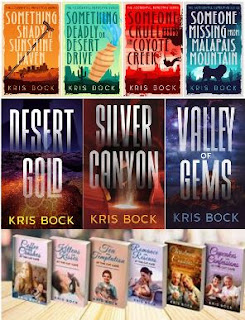
Chris also writes for adults under the name Kris Bock. 
She writes a series with her brother, scriptwriter Douglas J Eboch, who wrote the original screenplay for the movie Sweet Home Alabama. The Felony Melanie series follows the crazy antics of Melanie, Jake, and their friends a decade before the events of the movie. Sign up for the romantic comedy newsletter to get a short story preview, or find the books at Amazon US or All E-book retailers.

Kris Bock writes novels of mystery, suspense, and romance. In the Accidental Detective series, a witty journalist solves mysteries in Arizona and tackles the challenges of turning fifty. Kris’s Furrever Friends Sweet Romance series features the employees and customers at a cat café. In the Accidental Billionaire Cowboys series, a Texas ranching family wins a fortune in the lottery, which causes as many problems as it solves. 

Sign up for the Kris Bock Mystery and Romance newsletter and get a free Accidental Detective short story and bonus material, a free 30-page sweet romance set in the world of the Furrever Friends cat café, and a printable copy of the recipes mentioned in the cat café novels.

Learn more at her website or visit her Amazon page.

Saturday, March 3, 2018

Advanced Plotting Techniques Handout

Fast Start Options:
  • Start in the action, at a moment of change. Then work in the back story if needed.
  • Start with two people on the page.
  • Start with a scene, with action and dialogue. Use description and summary modestly, and only if really needed.
  • Start in the middle of a fight or other conflict.
  • Start with a cliffhanger – something powerful about to happen.
  • The inciting incident – the problem that gets the story going – should happen as soon as possible, but not until the moment is ripe. The reader must have enough understanding of the character and situation to make the incident meaningful. Too soon, and the reader is confused. Too late, and the reader gets bored first.
  • Try starting with a small problem that leads to the big problem, or is an example of the main problem.
  • See also “Beginnings” Label in the right-hand column.

Plot Tricks:
·      Use the rule of three – the main character should try and fail at least twice before solving the problem on the third try. In long works, use this for each challenge.
·      Increase the complications – at each step, more is at stake, there’s greater risk. If each scene has the same level of risk and consequence, the pacing is flat and the middle sags.
·      Up the ante – offer a better reward or more serious consequences.
·      A time deadline increases tension.
·      Give it a twist – new information that changes everything but still makes sense (Darth Vader is Luke’s father).
·      If you get stuck on “What happens next?” try looking from the antagonist’s POV. What are they doing to stop your character? Other characters can also add complications.
·      Keep your chapters short, and make sure every one has dramatic action.
·      Use the Plot Outline Exercise from Advanced Plotting
·      More important and dramatic events should be written out in detail, others can be summarized.
·      Use shorter words and sentences to speed the pace.
·      See also “Plotting” Label right-hand column.

Story Analysis Resources:
Chris Eboch’s book Advanced Plotting helps writers fine-tune their plots. Advanced Plotting is designed for the intermediate and advanced writer. If you struggle with plot or suspect your plotting needs work, this book can help. Use the Plot Outline Exercise to identify and fix plot weaknesses. Learn how to get off to a fast start, prop up a sagging middle, build to a climax, improve your pacing, and more.

Get Advanced Plotting from Amazon

Chris offers novel critiques for $2 per page ($100 minimum). Contact Chris for details and recommendations.

You Can Write for Children: How to Write Great Stories, Articles, and Books for Kids and Teenagers offers an overview on writing for young people. Learn how to find ideas and develop those ideas into stories, articles, and books. Understand the basics of character development, plot, setting, and theme – and some advanced elements, along with how to use point of view, dialogue, and thoughts. Finally, learn about editing your work and getting critiques.

You Can Write for Children: How to Write Great Stories, Articles, and Books for Kids and Teenagers is available for the Kindle, in paperback, or in Large Print paperback.

Chris Eboch is the author of over 50 books for children, including nonfiction and fiction, early reader through teen. Her novels for ages nine and up include The Eyes of Pharaoh, a mystery in ancient Egypt; The Well of Sacrifice, a Mayan adventure; The Genie’s Gift, a middle eastern fantasy; and the Haunted series, about kids who travel with a ghost hunter TV show, which starts with The Ghost on the Stairs. 


Chris also writes for adults under the name Kris Bock. Kris Bock writes action-packed romantic suspense involving outdoor adventures and Southwestern landscapes. The Mad Monk’s Treasure follows a treasure hunt in New Mexico and has been called “Smart romance with an Indiana Jones feel.”

Counterfeits starts a new series about art theft. What We Found is a mystery with romantic elements about a young woman who finds a murder victim in the woods. Whispers in the Dark involves intrigue among ancient Southwest ruins. Read excerpts at www.krisbock.com or visit her Amazon page. All books are free with Kindle Unlimited.

Saturday, July 8, 2017

Advanced Plotting Techniques With Chris Eboch from SCBWI 2017

I'm giving a workshop on "Advanced Plotting Techniques" at the SCBWI conference in LA today. Here's the handout for attendees.

Fast Start Options:
  • Start in the action, at a moment of change. Then work in the back story.
  • Start with two people on the page.
  • Start with a scene, with action and dialogue. Use description and summary modestly, and only if really needed.
  • Start in the middle of a fight or other conflict.
  • Start with a cliffhanger – something powerful about to happen.
  • The inciting incident – the problem that gets the story going – should happen as soon as possible, but not until the moment is ripe. The reader must have enough understanding of the character and situation to make the incident meaningful. Too soon, and the reader is confused. Too late, and the reader gets bored first.
  • Try starting with a small problem that leads to the big problem, or is an example of the main problem.
  • See also “Beginnings” Label below right

Plot Tricks:
·      Use the rule of three – the main character should try and fail at least twice before solving the problem on the third try. In long works, use this for each challenge.
·      Increase the complications – at each step, more is at stake, there’s greater risk. If each scene has the same level of risk and consequence, the pacing is flat and the middle sags.
·      Up the ante – offer a better reward or more serious consequences.
·      A time deadline increases tension.
·      Give it a twist – new information that changes everything but still makes sense (Darth Vader is Luke’s father).
·      If you get stuck on “What happens next?” try looking from the antagonist’s POV. What are they doing to stop your character? Other characters can also add complications.
·      Keep your chapters short, and make sure every one has dramatic action.
·      Use the Plot Outline Exercise from Advanced Plotting (Kindle on sale 50% off July 7-14)
·      More important and dramatic events should be written out in detail, others can be summarized.
·      Use shorter words and sentences to speed the pace.
·      See also “Plotting” Label below right.
·      See also “Cliffhangers” Label below right


Story Analysis Resources:

Chris Eboch’s book Advanced Plotting helps writers fine-tune their plots. Advanced Plotting is designed for the intermediate and advanced writer. If you struggle with plot or suspect your plotting needs work, this book can help. Use the Plot Outline Exercise to identify and fix plot weaknesses. Learn how to get off to a fast start, prop up a sagging middle, build to a climax, improve your pacing, and more.

Get Advanced Plotting from Amazon (Kindle on sale 50% off July 7-14).

Chris offers novel critiques for $2 per page ($100 minimum). Contact Chris for details and recommendations.

Chris Eboch is the author of over 40 books for children, including nonfiction and fiction, early reader through teen. Her novels for ages nine and up include The Eyes of Pharaoh, a mystery in ancient Egypt; The Well of Sacrifice, a Mayan adventure; The Genie’s Gift, a middle eastern fantasy; and the Haunted series, about kids who travel with a ghost hunter TV show, which starts with The Ghost on the Stairs. Her writing craft books include You Can Write for Children: How to Write Great Stories, Articles, and Books for Kids and Teenagers, and Advanced Plotting.


Chris also writes for adults under the name Kris Bock. Kris Bock writes action-packed romantic suspense involving outdoor adventures and Southwestern landscapes. The Mad Monk’s Treasure – free at all e-book retailers – follows a treasure hunt in New Mexico and has been called “Smart romance with an Indiana Jones feel.”

Counterfeits starts a new series about art theft. What We Found is a mystery with romantic elements about a young woman who finds a murder victim in the woods. Whispers in the Dark involves intrigue among ancient Southwest ruins. Read excerpts at www.krisbock.com or visit her Amazon page

Friday, July 7, 2017

Advanced Plotting Kindle #Sale - Improve Your Writing for Less Than $3

“The Plot Outline Exercise is a great tool!” 

Advanced Plotting is 50% off for the Kindle – only $2.99 – from July 7-14.

Advanced Plotting is designed for the intermediate and advanced writer: you’ve finished a few manuscripts, read books and articles on writing, taken some classes, attended conferences. But you still struggle with plot, or suspect that your plotting needs work.

This book can help.

The Plot Outline Exercise is designed to help a writer work with a completed manuscript to identify and fix plot weaknesses. It can also be used to help flesh out an outline. Additional articles address specific plot challenges, such as getting off to a fast start, propping up a sagging middle, building to a climax, and improving your pacing. A dozen guest authors share advice from their own years of experience.

Read the book straight through, study the index to find help with your current problem, or dip in and out randomly — however you use this book, you’ll find fascinating insights and detailed tips to help you build a stronger plot and become a better writer.

Readers say:

This really is helping me a lot. It's written beautifully and to-the-point. The essays really help you zero in on your own problems in your manuscript. The Plot Outline Exercise is a great tool!

I just read and—dissected—your well written  book: Advanced Plotting. It's now highlighted in bright orange and littered with many of those little 3M sticky labels.  GOOD JOB. There are too many just-for-beginners books out there. Yours was a delight.

Advanced Plotting is helping me to be more focused, to stop and ask the right questions, to dig deeper.

Get it now at Amazon. Advanced Plotting is free with Kindle Unlimited, or pick up the paperback for $9.99 and add an e-book copy for only $.99. 


Chris Eboch is the author of over 40 books for children, including nonfiction and fiction, early reader through teen. Her novels for ages nine and up include The Eyes of Pharaoh, a mystery in ancient Egypt; The Well of Sacrifice, a Mayan adventure; The Genie’s Gift, a middle eastern fantasy; and the Haunted series, about kids who travel with a ghost hunter TV show, which starts with The Ghost on the Stairs. Her writing craft books include You Can Write for Children: How to Write Great Stories, Articles, and Books for Kids and Teenagers, and Advanced Plotting.


Friday, November 2, 2012

Endings: The Storm before the Calm


I've been discussing building a strong novel. Of course an important part of the novel is the climax, the big ending. You want the climax to be the most dramatic part of the novel, so the reader walks away satisfied. But before we get to the climax itself, let's look at the moment right before the climax. My brother, script writer Doug Eboch, has this to say about movie plots:

“There’s one other critical structural concept you need to understand. That is the moment of apparent failure (or success). Whatever the Resolution to your Dramatic Question is, there needs to be a moment where the opposite appears to be inevitable. So if your character succeeds at the end, you need a moment where it appears the character will fail. And if your character fails at the end, you need a moment where they appear to succeed.” (The full essay is in my writing craft book, Advanced Plotting.)

I wondered whether this held equally true for novels. Looking through a few of the books on my shelf, certainly the climax is a crisis point where the reader may believe that everything is going wrong and the main character could fail.

In The Ghost on the Stairs, Tania is possessed by a ghost and her brother Jon isn’t sure if he’ll be able to save her.

In The Well of Sacrifice, Eveningstar is thrown into the sacrificial well, a watery pit surrounded by high cliffs, and realizes no one will rescue her.


In The Lion, the Witch, and the Wardrobe, the lion Aslan is killed and the good army is losing their battle.

In adult mystery or suspense novels, this may be the point where the bad guy has captured the hero or is threatening to kill him.

In a romance, this is the point where the couple is farthest apart and we wonder how they’ll ever resolve their differences to live happily ever after.

Does your story or novel have a crisis point, a moment at the climax where readers truly believe the main character could fail? If not, you may want to rethink your plot or rewrite the action to make the climax more intense and challenging. The happy ending is only satisfying if it is won at great expense through hard work. In literature as in real life, people don’t always value what comes easily. Success feels that much sweeter when it can be contrasted to the suffering we’ve had to endure.

Next week I'll talk about the climax itself.

See Doug’s entire 4000-word essay covering all the dramatic story points of three-act structure, plus much more, in Advanced Plotting. Buy Advanced Plottingfor $9.99 in paperback or as a $4.99 e-book on Amazon or Barnes & Noble, or in various e-book formats from Smashwords.

Douglas J. Eboch wrote the original script for Sweet Home Alabama. He teaches at Art Center College of Design and lectures internationally. He writes a blog about screenwriting at http://letsschmooze.blogspot.com/.

Friday, October 26, 2012

How to Write Vivid Scenes 3: Cause and Effect


I've been talking about writing vivid scenes, an important part of keeping suspense and tension up throughout your novel. Let's finish up our discussion on scenes with the rest of an essay adapted from my writing craft book, Advanced Plotting-- looking at cause and effect.

Cause and Effect

One of the ironies of writing fiction is that fiction has to be more realistic than real life. In real life, things often seem to happen for no reason. In fiction, that comes across as unbelievable. We expect stories to follow a logical pattern, where a clear action causes a reasonable reaction. In other words, cause and effect.

The late Jack M. Bickham explored this pattern in Scene & Structure, from Writer’s Digest Books. He noted that every cause should have an effect, and vice versa. This goes beyond the major plot action and includes a character’s internal reaction. When action is followed by action with no internal reaction, we don’t understand the character’s motives. At best, the action starts to feel flat and unimportant, because we are simply watching a character go through the motions without emotion. At worst, the character’s actions are unbelievable or confusing.

In Manuscript Makeover: Revision Techniques No Fiction Writer Can Afford to Ignore(Perigee Books), Elizabeth Lyon suggests using this pattern: stimulus—reaction/emotion—thoughts—action.
  • Something happens to your main character (the stimulus);
  • You show his emotional reaction, perhaps through dialog, an exclamation, gesture, expression, or physical sensation;
  • He thinks about the situation and makes a decision on what to do next;
  • Finally, he acts on that decision.

This lets us see clearly how and why a character is reacting. The sequence may take one sentence or several pages, so long as we see the character’s emotional and intellectual reaction, leading to a decision.

Bickham offered these suggestions for building strong scenes showing proper cause and effect:

The stimulus must be external—something that affects one of the five senses, such as action or dialog that could be seen or heard.

The response should also be partly external. In other words, after the character’s emotional response, she should say or do something. (Even deciding to say nothing leads to a reaction we can see, as the character turns away or stares at the stimulus or whatever.)

The response should immediately follow the stimulus. Wait too long and the reader will lose track of the original stimulus, or else wonder why the character waited five minutes before reacting.

Be sure you word things in the proper order. If you show the reaction before the action, it’s confusing: “Lisa hurried toward the door, hearing pounding.” For a second or two, we don’t know why she’s hurrying toward the door. In fact, we get the impression that Lisa started for the door before she heard the pounding. Instead, place the stimulus first: “Pounding rattled the door. Lisa hurried toward it.”

If the response is not obviously logical, you must explain it, usually with the responding character’s feelings/thoughts placed between the stimulus and the response. Here’s an example where the response is not immediately logical:

Knocking rattled the door. (Stimulus)
Lisa waited, staring at the door. (Action)

Why is she waiting? Does she expect someone to just walk in, even though they are knocking? Is she afraid? Is this not her house? To clarify, include the reaction:

Knocking rattled the door. (Stimulus)
Lisa jumped. (Physical Reaction) It was after midnight and she wasn’t expecting anyone. Maybe it was a mistake. Maybe they’d go away. (Thoughts)
She waited, staring at the door. (Responsive Action)

In some cases the response may be logical and obvious without including thoughts and emotions in between. For example, if character A throws a ball and character B raises a hand to catch it, we don’t need to hear character B thinking, “There’s a ball coming at me. I had better catch it.” But don’t assume your audience can always read between the lines. Often as authors we know why our characters behave the way they do, so we assume others will understand and we don’t put the reaction and thoughts on the page. This can lead to confusion.

In one manuscript I critiqued, the character heard mysterious voices. I assumed they were ghosts, but the narrator never identified them that way. Did he think they were something else? Did he think he was going crazy? Had he not yet decided? I couldn’t tell. The author may have assumed the cause of the voices was obvious, so she didn’t need to explain the character’s reaction. But it just left me wondering if I was missing something—or if the character was. Err on the side of showing your character’s thoughts.

Link your scenes together with scene questions and make sure you’re including all four parts of the scene—stimulus, reaction/emotion, thoughts, and action—and you’ll have vivid, believable scenes building a dramatic story.
  
 Advanced Plotting is designed for the intermediate and advanced writer: you’ve finished a few stories, read books and articles on writing, taken some classes, attended conferences. But you still struggle with plot, or suspect that your plotting needs work.
Advanced Plotting can help.
Buy Advanced Plottingfor $9.99 in paperback or as a $4.99 e-book on Amazon or Barnes & Noble, or in various e-book formats from Smashwords.

Friday, September 14, 2012

The Unity of Character and Plot, by Andrea J. Wenger


For my Friday craft posts, I've been talking about developing your novel. Let's explore building a strong middle in your novel by considering your characters. To start, I'm reposting this guest post by Andrea J. Wenger, who contributed an essay to my writing book, Advanced Plotting.

The Unity of Character and Plot

Several years ago, at the North Carolina Writers Network conference, I attended a session where the instructor claimed that character is plot. While I understand her point, I think she went too far. Many things happen in our lives that we can’t control. In fiction, the response to external events demonstrates character and propels plot. But generally, by the end of the story, the protagonist becomes proactive instead of responsive, and the protagonist’s positive action creates the climax.

Character and plot must work in harmony. For the story to be believable, the actions the character takes must be consistent with the character you’ve created. For instance, imagine if two of Shakespeare’s great tragic figures, Hamlet and Othello, were the protagonist in each other’s stories. How would those plays go?

Act I, Scene 1: The ghost of the old king tells Othello to avenge the old king’s death by killing Claudius.

Act I, Scene 2: Othello kills Claudius.

The End

No story, right? And if Iago hinted to Hamlet that Desdemona were cheating on him, Hamlet would answer, “You cannot play upon me.”

For the two plays to work, Othello’s hero must be action-oriented, while Hamlet’s hero must be introspective.

Keep in mind, though, that when under extreme stress, people (and characters) behave in ways they never would otherwise. In Writing the Breakout Novel, Donald Maass advises novelists to imagine something their character would never think, say, or do—then create a situation where the character thinks, says, or does exactly that. If it’s critical to your story that your character behave in uncharacteristic ways, put that character in an environment of increasing stress, until the point that the character’s “shadow” takes over.

Isabel Myers, co-author of the Myers-Briggs Type Indicator, defined the shadow function as the least developed part of our personality. Even in the best of times, we may have difficulty using this function in a rational and mature manner. When someone is under stress, and the shadow takes charge, the results can be disastrous.

In your own stories, do character and plot work in harmony? If a character behaves in an uncharacteristic way, be sure to show that the character is under enough stress to make the action believable.

Andrea J. Wenger is professional writer specializing in technical, freelance, and creative writing. Her short fiction has appeared in The Rambler. She is currently working on a women’s fiction novel. She blogs and speaks on the subject of writing and personality. She is a regular contributor to Carolina Communiqué, a publication of the Carolina Chapter of the Society for Technical Communication. www.WriteWithPersonality.com.

Get more essay like this one in Advanced Plotting, along with a detailed explanation of the Plot Outline Exercise, a powerful tool to identify and fix plot weaknesses in your manuscripts. Buy Advanced Plottingfor $9.99 in paperback or as a $4.99 e-book on Amazon or Barnes & Noble, or in various e-book formats from Smashwords.