Showing posts with label beginnings. Show all posts

Monday, October 5, 2020

“What do I do with my idea?” How to Turn Inspiration into a Great Story: #amwriting #writing #NaNoWriMo

National Novel Writing Month (NaNoWriMo) is a challenge designed to get people moving quickly through a first draft of a novel. Prep for November by starting with the NaNo Prep 101 or read on!

People often ask writers, “Where do you find your ideas?” But for a writer, the more important question is, “What do I do with my idea?”

If you have a “great idea,” but can’t seem to go anywhere with it, you probably have a premise rather than a complete story plan. A story has four main parts: situation, complications, climax, and resolution. You need all of them to make your story work.

The situation should involve an interesting main character with a challenging problem or goal. Even this takes development. Maybe you have a great challenge, but aren’t sure why a character would have that goal. Or maybe your situation is interesting, but doesn’t actually involve a problem.

For example, I wanted to write about a brother and sister who travel with a ghost hunter TV show. The girl can see ghosts, but the boy can’t. That gave me the characters and situation, but no problem or goal. Goals come from need or desire. What did they want that could sustain a series?

Tania feels sorry for the ghosts and wants to help them, while keeping her gift a secret from everyone but her brother. Jon wants to help and protect his sister, but sometimes feels overwhelmed by the responsibility. Now we have characters with problems and goals. The story is off to a good start.

•           Make sure your idea is specific and narrow. Focus on an individual person and situation, not a universal concept. For example, don’t try to write about “racism.” Instead, write about one character facing racism in a particular situation.

•           Ask why the goal is important to the character. The longer the story, the higher stakes needed to sustain it. A short story character might want to win a contest; a novel character might need to save the world.

•           Ask why this goal is difficult. Difficulties fall into categories traditionally called man versus man, man versus nature, and man versus himself. You can even combine these. Your character may hunt bank robbers (person versus person) during a dangerous storm (person versus nature) when he is afraid of lightning (person versus himself).

•           Even if your main problem is external, give the character an internal flaw that contributes to the difficulty. This adds complications and also makes your character seem more real. For some internal flaws, see the seven deadly sins: lust, gluttony, greed, sloth, wrath, envy, and pride.

•           Test the idea. Change the character’s age, gender, or looks. Change the point of view, setting, external conflict, internal conflict. Choose the combination that has the most dramatic potential.

Next time: Building the middle of your story.

For more help on developing your stories, check out these titles: 

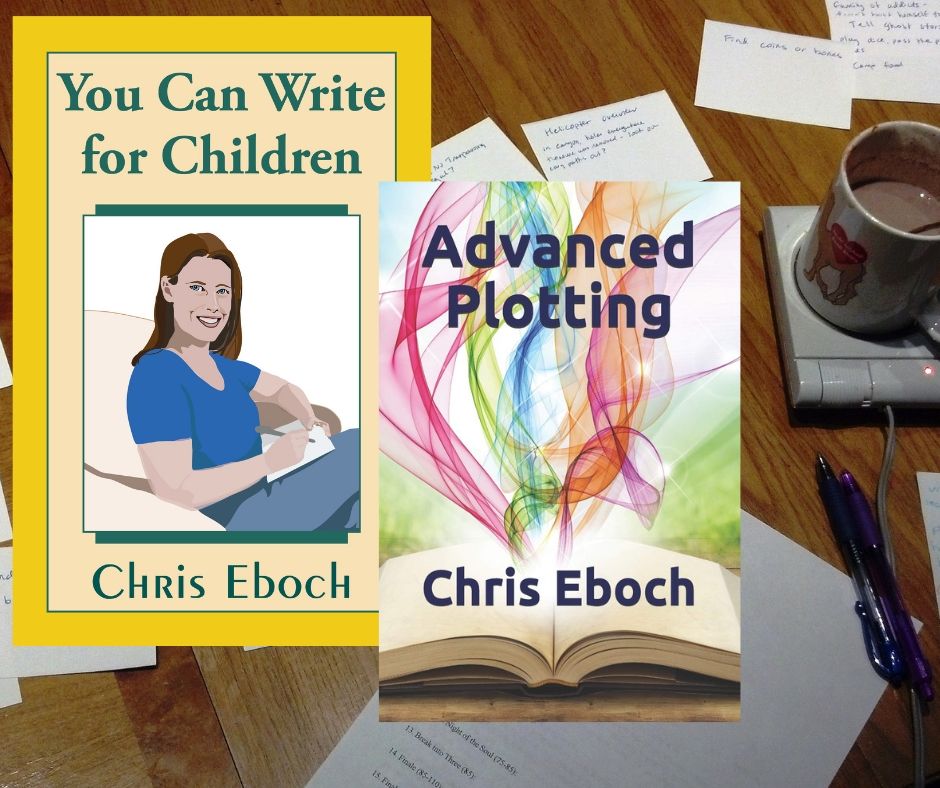
You Can Write for Children: How to Write Great Stories, Articles, and Books for Kids and Teenagers is available for the Kindle, in paperback, or in Large Print paperback

Advanced Plotting is designed for the intermediate and advanced writer: you’ve finished a few manuscripts, read books and articles on writing, taken some classes, attended conferences. But you still struggle with plot or suspect that your plotting needs work. This book can help.


Chris Eboch is the author of over 60 books for children, including nonfiction and fiction, early reader through teen. Her novels for ages nine and up include The Eyes of Pharaoh, a mystery in ancient Egypt; The Well of Sacrifice, a Mayan adventure; The Genie’s Gift, a middle eastern fantasy; and the Haunted series, about kids who travel with a ghost hunter TV show, which starts with The Ghost on the Stairs. Her writing craft books include You Can Write for Children: How to Write Great Stories, Articles, and Books for Kids and Teenagers, and Advanced Plotting.

Learn more or read excerpts at www.chriseboch.com or visit her page on Amazon or Amazon UK. (For other countries click here.)

Saturday, June 15, 2019

Novel First Chapters: Opening Exercises #amwriting

I've been talking about the promise a first chapter makes, and how to get off to a fast start. Now try these exercises to explore how openings make promises.

First Chapters in Novels: Opening Exercises

Pick up one of your favorite novels. Reread the first chapter. What promises does it make? From your knowledge of the book, does it fulfill those promises? Repeat this exercise with other books. Try it with short stories and articles, judging the promises made in the first few lines.

When you start reading a new novel, pause at the end of the first chapter. Could you identify the genre, main character, point of view, and setting? Is the main character facing a challenge? Make a note of these promises. At the end of the book, decide whether each promise was fulfilled. Try reading short stories and articles this way as well.

Think about your work in progress. What do you want to promise? Check your first chapter for each of the following:

  • Does it clearly identify the genre?
  • Does it identify the setting, including time period, country, and urban/rural/suburban lifestyle? Does it suggest whether this is a school story, a family story, an epic interstellar journey, or whatever?
  • Does it introduce the main character and possibly one or more other important characters?
  • Does it clearly establish the point of view and the tone of the book (funny, lyrical, intellectual, or whatever)?
  • Is a problem introduced quickly? If it is not the primary plot problem, does the opening challenge at least relate to or lead to the main problem?

Few authors wind up using their original openings. Some authors write a novel, then throw away the first chapter and write a new first chapter — the one that belongs there. It seems like it’s almost impossible to write a strong opening until you’ve finished the rest of the book. The final version of the opening may actually be the last thing we write!

Openings are a struggle for many of us, but don’t worry about the beginning during the first draft. Chances are it will change completely anyway, so wait until you have a solid plot before you start fine-tuning your opening. You need to know the rest of your story in order to figure out what your opening should be.

Don’t stress about the opening during your early drafts, but do make sure you fix it later. Keep in mind that fixing the beginning may involve throwing it out altogether and replacing it with something else or simply starting later in the story. In the end, you’ll have the beginning you need.

Get More Writing Advice

In Advanced Plotting, you'll get two dozen essays like this one on the craft of writing. Advanced Plotting is designed for the intermediate and advanced writer: you’ve finished a few stories, read books and articles on writing, taken some classes, attended conferences. But you still struggle with plot, or suspect that your plotting needs work.

Advanced Plotting can help.

Chris Eboch is the author of over 60 books for children, including nonfiction and fiction, early reader through teen. Her writing craft books include You Can Write for Children: How to Write Great Stories, Articles, and Books for Kids and Teenagers, and Advanced Plotting.

Her novels for ages nine and up include The Eyes of Pharaoh, a mystery in ancient Egypt; The Well of Sacrifice, a Mayan adventure; The Genie’s Gift, a middle eastern fantasy; and the Haunted series, about kids who travel with a ghost hunter TV show, which starts with The Ghost on the Stairs. Learn more at https://chriseboch.com/ or her Amazon page.

Saturday, June 8, 2019

Novel First Chapters: The Fast Start - #amwriting


Last week I talked about the promise a first chapter makes to the reader, and what you should include. This essay from Advanced Plotting continues with advice on getting off to a fast start.


Starting Your Novel Quickly 

An opening introduces many elements of the story. Yet you can’t take too long to set the scene, or your readers may lose interest. You want to start in a moment of action, where something is changing, and cut the background. But don’t rush things — take a little time to set up the situation, so it makes sense and we care about the characters and what’s happening to them.

Fast, but not too fast. How do you find the balance?

You can test your opening by seeing how much you can cut. What if you delete the first sentence, the first paragraph, the first page? Does the story still make sense? Does it get off to a faster start? For a novel, what if you cut the whole first chapter, or several chapters? If you can’t cut, can you condense?

On the other hand, if your beginning feels confusing or rushed, you might want to try starting earlier in the story. Try setting up a small problem that grabs the reader’s attention, luring them in until you can get to the main problem. In my novel The Well of Sacrifice, the Maya are dealing with famine, disease, and marauders in the early chapters, even before the king dies and an evil high priest tries to take over. That gives readers time to understand these characters and their unusual world.

My Egyptian mystery, The Eyes of Pharaoh, opens with the main character running — an active scene, even though she’s merely running for pleasure. In the rest of that first chapter, Seshta, a young temple dancer, is focused on a dance contest she wants to win. This introduces a challenge and a goal, and the contest is a major subplot throughout the book, though not the primary plot line. By the end of the first chapter, Seshta’s friend Reya, a young soldier, warns her that Egypt may be in danger. She doesn’t believe him, but the reader has seen the seeds of the main plot, which will develop when Reya disappears and Seshta searches for him, uncovering a plot against the Pharaoh.

The inciting incident — the problem that gets the story going — should happen as soon as possible, but not until the moment is ripe. The reader must have enough understanding of the character and situation to make the incident meaningful. Too soon, and the reader is confused. Too late, and the reader gets bored first.

Options for Fast Starts:

· Start in the action, at a moment of change. Then work in the back story.
· Start with two people on the page.
· Start in the middle of a fight or other conflict.
· Start with a cliffhanger — something powerful about to happen.
· Start with a small problem that leads to the big problem, or is an example of the main problem.

Keeping Your Writing Style 

With all the pressure to write a great opening, people often struggle to find an opening scene that is dramatic, powerful, and eye-catching! Something that will make the reader want to keep reading!!!

We may see our opening as something almost separate from the full manuscript — something we can submit to a first pages critique or send to an editor or agent who only wants to see a few pages as a sample. But treating the opening paragraphs as an ad may not be best for the rest of the manuscript. A clever, funny hook is great — but only if the rest of the book is also clever and funny.

Many readers will browse a book’s opening pages in a library or bookstore to decide if they want to take the book home. If you offer the reader a fast-paced, action-packed opening, when your book is really a subtle emotional drama with lyrical descriptive writing, you’re going to disappoint the readers who enjoyed the opening. Even worse, readers who would have enjoyed the whole book might never get past the opening page.

The same holds true for stories on a smaller scale. Even if your story only lasts a few pages, your readers are making judgments during your opening lines. Don’t confuse them by starting one way and then turning the story into something else.

Next week: Opening Exercises

Chris Eboch is the author of over 60 books for children, including nonfiction and fiction, early reader through teen. Her writing craft books include You Can Write for Children: How to Write Great Stories, Articles, and Books for Kids and Teenagers, and Advanced Plotting.

Her novels for ages nine and up include The Eyes of Pharaoh, a mystery in ancient Egypt; The Well of Sacrifice, a Mayan adventure; The Genie’s Gift, a middle eastern fantasy; and the Haunted series, about kids who travel with a ghost hunter TV show, which starts with The Ghost on the Stairs. Learn more at https://chriseboch.com/ or her Amazon page.

Saturday, June 1, 2019

The Promise of the First Chapter: #Writing Advice #amwriting


The Promise of the First Chapter

You’ll hear it over and over again — opening lines are important. Your opening makes a promise about the rest of the story, article, or book. It tells readers what to expect, setting the stage for the rest of the story to unfold — and hopefully hooking their interest.

What You Promise

The first scene should identify your story’s genre. This can be trickier than it sounds. Say it’s a romance, but the main character doesn’t meet the love interest until later. Can you at least suggest her loneliness or desire for romance? (And get that love interest in there as soon as possible!)

Maybe you’re writing a story involving magic, time travel, ghosts, or a step into another dimension, but you want to show the normal world before you shift into fantasy. That’s fine, but if we start reading about a realistic modern setting and then halfway through magic comes out of nowhere, you’ll surprise your reader — and not in a good way. Your story will feel like two different stories clumsily stitched together.

If you’re going to start “normal” and later introduce an element like magic or aliens, try to hint at what’s to come. Maybe the main character is wishing that magic existed — that’s enough to prepare the reader. In my novel The Ghost on the Stairs, we don’t find out that the narrator’s sister has seen a ghost until the end of chapter 2. But on the opening page, she comments that the hotel “looks haunted” and is “spooky.” Those words suggest that a ghost story may be coming. That’s enough to prep the reader. (The title doesn’t hurt either.)

Your opening should also identify the story’s setting. This includes when and where we are, if it’s historical or set in another country or world. Once again, you don’t want your reader to assume a modern story and then discover halfway through that it’s actually a historical setting. They’ll blame you for their confusion. In a contemporary story, you may not identify a specific city, but the reader should have a feel for whether this is inner-city, small-town, suburban, or whatever.

Who and What’s Up in Your Novel's Opening Pages

Your opening pages should focus on your main character. You may find exceptions to this rule, but your readers will assume that whoever is prominent in the opening pages is the main character. Switching can cause confusion. You should also establish your point of view early. If you’ll be switching points of view, don’t wait too long to make the first switch. In novels, typically you want to show your alternate point of view in the second chapter and then switch back and forth with some kind of regular rhythm.

And of course, you want some kind of challenge or conflict in your opening. This doesn’t have to be the main plot problem — you may need additional set up before your main character takes on that challenge or even knows about it. But try to make sure that your opening problem relates to the main problem. It may even lead to it.

In The Ghost on the Stairs, Tania faints at the end of chapter 1. Jon does not yet know why, but this opening problem leads to the main problem — she’d seen a ghost. If I’d used an entirely different opening problem, say stress with their new stepfather, that would have suggested a family drama, not a paranormal adventure.

In a short story, you need to introduce your main conflict even more quickly. A story I sold to Highlights started like this:

Jaguar Paw watched the older Mayan boys play pok-a-tok. The ball skidded around the court as the players tried to keep it from touching the ground. They used their arms, knees, and hips, but never their hands or feet. The best pok-a-tok players were everybody’s heroes. These boys were just practicing. But that meant Jaguar Paw could watch from the edge of the court.

That opening paragraph, 64 words, introduces the main character, identifies the foreign, historical setting, includes a specific location (the ball court), and hints at Jaguar Paw’s desire to be a ballplayer. Genre, setting, main character, and conflict, all up front.

Next week: The Fast Start


Get More Writing Advice

Chris Eboch is the author of over 60 books for children, including nonfiction and fiction, early reader through teen. Her writing craft books include You Can Write for Children: How to Write Great Stories, Articles, and Books for Kids and Teenagers, and Advanced Plotting.

Her novels for ages nine and up include The Eyes of Pharaoh, a mystery in ancient Egypt; The Well of Sacrifice, a Mayan adventure; The Genie’s Gift, a middle eastern fantasy; and the Haunted series, about kids who travel with a ghost hunter TV show, which starts with The Ghost on the Stairs. Learn more at https://chriseboch.com/ or her Amazon page.

Saturday, May 4, 2019

Building a Story in Four Parts - Quick #Writing tips for #KidLit or any Writing


I hope these quick writing tips helps you jumpstart your writing!

This series on Developing Ideas is excerpted from You Can Write for Children: How to Write Great Stories, Articles, and Books for Kids and Teenagers. Get the book if you want to see all the info at once. The book addresses writing stories for children, but if you want to write for adults, simply do the exercises ignoring the "as a child" part.

A Story in Four Parts

Last week I talked about how a story should have a beginning, middle, and end.

If “beginning, middle, and end” doesn’t really help you, here’s another way to think of story structure. A story has four main parts: situation, complications, climax, and resolution. You need all of them to make your story work. (This is really the same as beginning, middle, and end, with the end broken into two parts, but the terms may be clearer.)

The situation should involve an interesting main character with a challenging problem or goal. Even this takes development. Maybe you have a great challenge, but aren’t sure why a character would have that goal. Or maybe your situation is interesting, but it doesn’t actually involve a problem.

For example, I wanted to write about a brother and sister who travel with a ghost hunter TV show. The girl can see ghosts, but the boy can’t. That gave me the characters and situation, but no problem or goal. Goals come from need or desire. What did they want that could sustain a series?

Tania feels sorry for the ghosts and wants to help them, while keeping her gift a secret from everyone but her brother. Jon wants to help and protect his sister, but sometimes he feels overwhelmed by the responsibility. Now we have characters with problems and goals. The story is off to a good start. (This became the four-book Haunted series.)

Tips for Great Story Goals and Stakes:

  • Make sure your idea is specific and narrow. Focus on an individual person and situation, not a universal concept. For example, don’t try to write about “racism.” Instead, write about one character facing racism in a particular situation.
  • The longer the story, the higher the stakes needed to sustain it. A short story character might want to win a contest; a novel character might need to save the world.
  • Ask why the goal is important to the character. Why does this particular individual desperately want to succeed in this challenge?
  • Ask why this goal is difficult. If reaching the goal is too easy, there is little tension and the story is too short. The goal should be possible, but just barely. It might even seem impossible. The reader should believe that the main character could fail. (More on this in in You Can Write for Children: How to Write Great Stories, Articles, and Books for Kids and Teenagers, Chapter 5: Characters.)
  • Even if your main problem is external, try giving the character an internal flaw that contributes to the difficulty. This adds complications and also makes your character seem more real. For some internal flaws, see the seven deadly sins: lust, gluttony, greed, sloth, wrath, envy, and pride.
  • Test the idea. Change the character’s age, gender, or looks. Change the point of view, setting, external conflict, or internal conflict. Choose the combination that has the most dramatic potential.


Stop back next week (or follow the blog) and we'll go into more detail on building the middle of your story.

Get More Writing Advice

Chris Eboch is the author of over 60 books for children, including nonfiction and fiction, early reader through teen. Her writing craft books include You Can Write for Children: How to Write Great Stories, Articles, and Books for Kids and Teenagers, and Advanced Plotting.
Her novels for ages nine and up include The Eyes of Pharaoh, a mystery in ancient Egypt; The Well of Sacrifice, a Mayan adventure; The Genie’s Gift, a middle eastern fantasy; and the Haunted series, about kids who travel with a ghost hunter TV show, which starts with The Ghost on the Stairs. Learn more at https://chriseboch.com/ or her Amazon page.

Chris also writes for adults under the name Kris Bock. Kris Bock novels are action-packed romantic adventures set in Southwestern landscapes. Fans of Mary Stewart, Barbara Michaels, and Terry Odell will want to check out Kris Bock’s romantic adventures. “Counterfeits is the kind of romantic suspense novel I have enjoyed since I first read Mary Stewart’s Moonspinners.” 5 Stars – Roberta at Sensuous Reviews blog

Read excerpts at www.krisbock.com or visit her Amazon page. Sign up for the Kris Bock newsletter for announcements of new books, sales, and more.

Friday, August 17, 2012

Open Strong: First Chapter Exercises


I’ve been talking about the promise a first chapter makes and how to open strong. Now try these exercises to explore how the first chapter makes promises.

Pick up one of your favorite novels. Reread the first chapter. What promises does it make? From your knowledge of the book, does it fulfill those promises? Repeat this exercise with other books. Try it with short stories and articles, judging the promises made in the first few lines.

When you start reading a new novel, pause at the end of the first chapter. Could you identify the genre, main character, point of view, and setting? Is the main character facing a challenge? Make a note of these promises. At the end of the book, decide whether each promise was fulfilled. Try reading short stories and articles this way as well.

Think about your work in progress. What do you want to promise? Check your first chapter for each of the following:
  • Does it clearly identify the genre?
  • Does it identify the setting, including time period, country, and urban/rural/suburban lifestyle? Does it suggest whether this is a school story, a family story, an epic interstellar journey, or whatever?
  • Does it introduce the main character and possibly one or more other important characters?
  • Does it clearly establish the point of view and the tone of the book (funny, lyrical, intellectual, or whatever)?
  • Is a problem introduced quickly? If it is not the primary plot problem, does the opening challenge at least relate to or lead to the main problem?
Few authors wind up using their original openings. Some authors write a novel, then throw away the first chapter and write a new first chapter — the one that belongs there. It seems like it’s almost impossible to write a strong opening until you’ve finished the rest of the book. The final version of the opening may actually be the last thing we write!

Openings are a struggle for many of us, but don’t worry about the beginning during the first draft. Chances are it will change completely anyway, so wait until you have a solid plot before you start fine-tuning your opening. You need to know the rest of your story in order to figure out what your opening should be.

Don’t stress about the opening during your early drafts, but do make sure you fix it later. Keep in mind that fixing the beginning may involve throwing it out altogether and replacing it with something else or simply starting later in the story. In the end, you’ll have the beginning you need.

In Advanced Plotting, you’ll get two dozen essays like this one on the craft of writing. Advanced Plotting is designed for intermediate and advanced writers: you’ve finished a few stories, read books and articles on writing, taken some classes, attended conferences. But you still struggle with plot, or suspect that your plotting needs work.

Advanced Plotting can help. 

Buy Advanced Plotting for $9.99 in paperback, $4.99 ebook, on Amazon,  B&N or Smashwords.

Friday, August 10, 2012

Strong Starts: The Hollywood Touch

I've been talking about getting your books off to a strong start. Now let’s go to Hollywood for some advice. I had the chance to interview some scriptwriters for a Writer’s Digest article some years ago. I’m adapting and expanding on that article. 

Authors dream of having their books made into movies. But even if your story never hits the big screen, you can make your work better by thinking like a scriptwriter. Apply screenwriting tricks to writing your novel and breathe new life into your work.

Let’s begin at the beginning and look at one important part of a manuscript, the opening. You know how important this is—editors and agents often say they can judge a manuscript on the first few pages. But don’t let the pressure get to you. You can put together an opening that grabs your readers and doesn’t let go.

OPEN BIG

I missed the connection between screenplays and novels for a long time. But when a middle grade novel just wasn’t connecting with readers, I consulted with my brother, Doug Eboch, who wrote the original screenplay for the film Sweet Home Alabama. After reading my manuscript, he told me, “You need a big opening scene. Think of visuals, color and movement—maybe a big party.”

He has a good point: Begin your novel with action, not background, to grab the reader’s attention. “Start with something big and memorable,” says David Steinberg, who wrote the screenplay for Slackers and co-wrote American Pie 2. “And big isn’t as important as memorable. It doesn’t have to be a big explosion, but start off with something exciting, different, weird—something that makes the reader want to keep going.”

Don Hewitt, who co-wrote the English-language screenplay for the Japanese animated film Spirited Away, agrees. But, he warns, don’t just make up any big scene for the sake of drama. “Start with an event that affects the character,” he says. Ideally, this event is a moment of change, where the character starts on a new path.

Establishing the protagonist’s role in the story is one of the most important functions of an opening, whether in films or novels. Let the reader know the character’s goals. “What does he want? What does he really need?” asks Steinberg. “What’s his external goal? And what’s his internal goal—what’s this person’s flaw, and how is he going to be a better person by the end?”

In addition, Doug says, “An opening scene should establish the genre. For comedy, I try to make a really funny opening.” In one of his screenplays, Quiver, a woman finds Cupid’s bow and arrow. “I open with Cupid to establish that it’s a comedy with a supernatural element.”

If the opening is exciting, funny, sad or scary, the audience expects the entire movie—or book—to be the same. If the opening is boring, the reader assumes the rest is, too. I took my brother’s advice. Now my first chapter has exotic scenery, magic, humor and a huge food fight. And I found a way to work important setup information into all that action.

For more on first chapter challenges and getting off to a fast start, click on the link to “beginnings” in the column to the right. If you’d like more insight into how a Hollywood scriptwriter works, check out my brother’s blog, Let’s Schmooze.

Adaptation
Here are a few more screenwriters’ tips you can put to work in your novel.

Planning: Paul Guay spent three months plotting his screen adaptation of the Piers Anthony novel On a Pale Horse before beginning to write. “I plan the entire thing out scene by scene before I write one word of dialogue or description. I know exactly what my beginning is and what my ending is.”

Character Development: Don Hewitt says, “It’s easy to have things happen to the character. He’s passive. But it’s always best that the action happens because of a choice.” Hewitt tries to base characters on real people. For him, it’s easier to know how they would really react and talk in any given situation.

Setup: David Steinberg notes that a lot of comedy comes from deception, such as a person pretending to be something he isn’t. The longer he has to keep the secret, the more tension he creates. “If you’ve set up the tension, it should be easy to write,” he says. “If you can’t come up with anything, it’s because you haven’t set up the opposing forces.”

Advanced Plotting has tons of advice on building strong plots, including a detailed essay from Doug Eboch on the script writing "turning points" and how to use them. Buy Advanced Plotting for $9.99 in paperback, $4.99 ebook, on Amazon,  B&N or Smashwords.


Friday, August 3, 2012

Start with a Bang: Strong First Chapters


Last week I talked about the promise a first chapter makes to the reader, and what you should include. This essay from Advanced Plotting continues with advice on getting off to a fast start so you create a strong first chapter.

The Fast Start


An opening introduces many elements of the story. Yet you can’t take too long to set the scene, or your readers may lose interest. You want to start in a moment of action, where something is changing, and cut the background. But don’t rush things — take a little time to set up the situation, so it makes sense and we care about the characters and what’s happening to them.

Fast, but not too fast. How do you find the balance?

You can test your opening by seeing how much you can cut. What if you delete the first sentence, the first paragraph, the first page? Does the story still make sense? Does it get off to a faster start? For a novel, what if you cut the whole first chapter, or several chapters? If you can’t cut, can you condense?

On the other hand, if your beginning feels confusing or rushed, you might want to try starting earlier in the story. Try setting up a small problem that grabs the reader’s attention, luring them in until you can get to the main problem. In my novel The Well of Sacrifice, the Maya are dealing with famine, disease, and marauders in the early chapters, even before the king dies and an evil high priest tries to take over. That gives readers time to understand these characters and their unusual world.

My Egyptian mystery, The Eyes of Pharaoh, opens with the main character running — an active scene, even though she’s merely running for pleasure. In the rest of that first chapter, Seshta, a young temple dancer, is focused on a dance contest she wants to win. This introduces a challenge and a goal, and the contest is a major subplot throughout the book, though not the primary plot line. By the end of the first chapter, Seshta’s friend Reya, a young soldier, warns her that Egypt may be in danger. She doesn’t believe him, but the reader has seen the seeds of the main plot, which will develop when Reya disappears and Seshta searches for him, uncovering a plot against the Pharaoh.

The inciting incident — the problem that gets the story going — should happen as soon as possible, but not until the moment is ripe. The reader must have enough understanding of the character and situation to make the incident meaningful. Too soon, and the reader is confused. Too late, and the reader gets bored first.
  
Options for Fast Starts:

· Start in the action, at a moment of change. Then work in the back story.
· Start with two people on the page.
· Start in the middle of a fight or other conflict.
· Start with a cliffhanger — something powerful about to happen.
· Start with a small problem that leads to the big problem, or is an example of the main problem.

Keeping Your Tone

With all the pressure to write a great opening, people often struggle to find an opening scene that is dramatic, powerful, and eye-catching! Something that will make the reader want to keep reading!!!

We may see our opening as something almost separate from the full manuscript — something we can submit to a first pages critique or send to an editor or agent who only wants to see a few pages as a sample. But treating the opening paragraphs as an ad may not be best for the rest of the manuscript. A clever, funny hook is great — but only if the rest of the book is also clever and funny.

Many readers will browse a book’s opening pages in a library or bookstore to decide if they want to take the book home. If you offer the reader a fast-paced, action-packed opening, when your book is really a subtle emotional drama with lyrical descriptive writing, you’re going to disappoint the readers who enjoyed the opening. Even worse, readers who would have enjoyed the whole book might never get past the opening page.

The same holds true for stories on a smaller scale. Even if your story only lasts a few pages, your readers are making judgments during your opening lines. Don’t confuse them by starting one way and then turning the story into something else.

Next week: Opening Exercises

In Advanced Plotting, you’ll get two dozen essays like this one on the craft of writing. Advanced Plotting is designed for intermediate and advanced writers: you’ve finished a few stories, read books and articles on writing, taken some classes, attended conferences. But you still struggle with plot, or suspect that your plotting needs work. 

Advanced Plotting can help. Buy Advanced Plotting for $9.99 in paperback, $4.99 ebook, on Amazon,  B&N or Smashwords.